
ODS-E in the Open Source Energy Ecosystem
Modern energy analytics, grid simulation, and artificial intelligence rely on an increasingly mature landscape of open source scientific tools: pvlib-python for photovoltaic performance modeling, OpenOA for operational wind farm assessment, NREL’s modeling stack (SAM, ComStock, ResStock) for building stock and grid distribution planning, and emerging agentic frameworks like PowerAgent for autonomous control-room operations.
However, all of these libraries share an identical vulnerability: the physical ingest bottleneck.
This page explains how ODS-E acts as the foundational data substrate across this ecosystem, mapping the business cases, levels of abstraction, and technical touchpoints for each library.
Ecosystem Architecture at a Glance
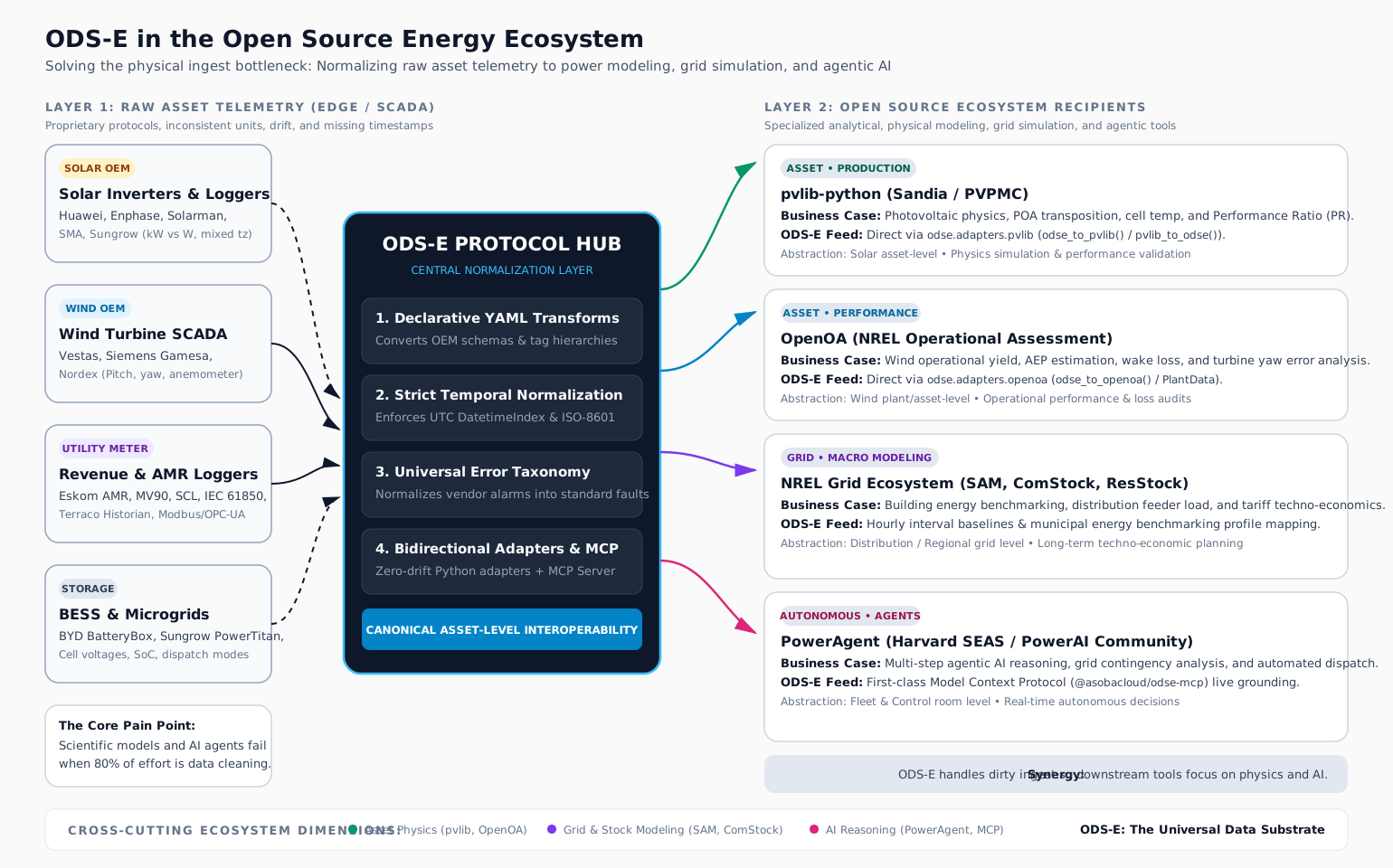
The Core Pain Point ODS-E Solves
Scientific libraries excel at physical equations, probabilistic simulations, and grid network dynamics. LLM-based autonomous agents excel at multi-step reasoning and operator interaction.
None of them were built to parse proprietary vendor SCADA protocols, normalize inconsistent manufacturer units (kW vs. W vs. MW), reconcile conflicting timezones (+02:00 vs. local vs. UTC), or disambiguate proprietary error codes.
In production environments, engineering teams routinely spend 70% to 80% of their operational budget writing bespoke extract-transform-load (ETL) scripts to feed standard tools:
| Domain Challenge | Without ODS-E | With ODS-E |
|---|---|---|
| Multi-OEM Ingest | Bespoke parsers per OEM (Huawei, Sungrow, Vestas, Enphase, Solarman) | Declarative YAML transforms map any vendor format to standard schema |
| Unit & Key Ambiguity | Irradiance in W/m² vs kW/m², active power casing mismatches | Strict canonical keys (active_power_kW, poa_irradiance, wind_speed_ms) |
| Temporal Alignment | Mixed timezones, DST offsets, and unordered timestamps break time series | Enforced UTC ISO-8601 timestamps and sorted pd.DatetimeIndex |
| Error Taxonomy | Vendor error codes (e.g., Code 2061 vs Event 0x4F) require manual lookups | Normalized error classes across all solar, wind, and storage assets |
| LLM Agent Grounding | LLMs hallucinate schema keys and stumble on dirty CSV exports | Structured Model Context Protocol (@asobacloud/odse-mcp) tools |
Ecosystem Component Breakdown
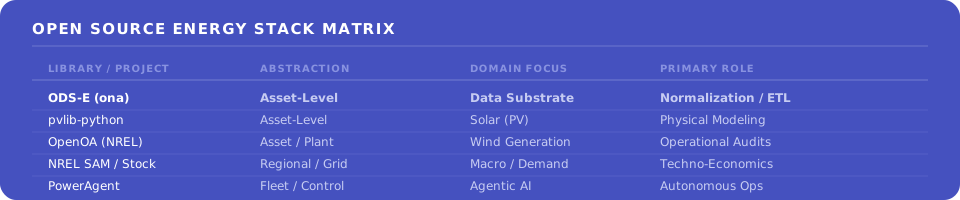
The open source energy stack spans multiple dimensions: Asset vs. Grid level, Current-State Performance vs. Future-State Modeling, and Production vs. Distribution.
Here is how each major open source pillar functions and where ODS-E interacts with it:
1. pvlib-python (Sandia National Laboratories / PVPMC)
- Business Case: The global standard for photovoltaic system physics. Calculates plane-of-array (POA) irradiance transposition, solar zenith and azimuth angles, PV module and cell temperature, inverter clipping losses, and Performance Ratio (PR).
- Level of Abstraction: Asset Level (individual strings, inverters, and weather pyranometers).
- Temporal / Operational Mode: Both Current-State Performance Validation (comparing actual inverter output against expected physical models) and Forward Modeling (simulating future generation under TMY weather datasets).
- Grid Horizon: Generation / Behind-the-Meter Production.
- How ODS-E Feeds It:
- ODS-E provides the first-class
odse.adapters.pvlibmodule (odse_to_pvlib()andpvlib_to_odse()). - Ingests normalized ODS-E telemetry and formats it directly into
pvlib.iotools-compliant pandas DataFrames with UTCDatetimeIndex. - Guarantees zero unit ambiguity (maps canonical
active_power_kW$\rightarrow$p_mp,poa_irradiance$\rightarrow$poa_global,module_temperature_c$\rightarrow$temp_cell). - Read the pvlib Integration Guide.
- ODS-E provides the first-class
2. OpenOA (National Renewable Energy Laboratory - NREL)
- Business Case: Comprehensive operational assessment and performance evaluation for commercial wind power plants. Quantifies Annual Energy Production (AEP), plant availability, turbine wake losses, yaw misalignment, and electrical losses between turbine terminals and revenue meters.
- Level of Abstraction: Asset to Plant Level (turbine-level 10-minute SCADA, meteorological mast tower measurements, and plant revenue meters).
- Temporal / Operational Mode: Current-State & Historical Performance Auditing (evaluating operational degradation, turbine curtailment losses, and pre-construction vs. post-construction yield).
- Grid Horizon: Bulk Generation / Utility-Scale Wind Farms.
- How ODS-E Feeds It:
- ODS-E provides
odse.adapters.openoa(odse_to_openoa()andopenoa_to_odse()). - Assembles disparate ODS-E telemetry streams into multi-table structures (
scada,tower,meter) or OpenOAPlantDataobjects. - Preserves multi-turbine
asset_idpartitioning, normalizes anemometer and nacelle yaw coordinates ($0^\circ \text{–} 360^\circ$), and handles auxiliary turbine power vs. grid curtailment. - Read the OpenOA Integration Guide.
- ODS-E provides
3. NREL Grid & Building Ecosystem (SAM, ComStock, ResStock)
- Business Case: Macro-scale energy planning, building stock electrification benchmarking, regional distribution network load synthesis, and tariff techno-economic analysis.
- System Advisor Model (SAM): Models financial cash flows, PPA contracts, and levelized cost of energy (LCOE).
- ComStock & ResStock: High-resolution building energy modeling capturing hourly heating, cooling, and electrification profiles across entire municipal housing and commercial building stocks.
- Level of Abstraction: Distribution & Regional Grid Level (feeder-level demand, substation load aggregation, and city-wide building archetypes).
- Temporal / Operational Mode: Macro-Level Planning & Predictive Modeling (evaluating multi-decade clean energy transitions, tariff restructuring, and grid capacity upgrades).
- Grid Horizon: Distribution & Consumption.
- How ODS-E Feeds It:
- ODS-E supplies normalized interval load data and municipal building metering baselines through its ComStock/ResStock integration mappings.
- Reconciles physical smart meter and AMR exports into standardized 15-minute or hourly interval timeseries, allowing empirical validation of synthetic stock models against real customer meter telemetry.
- Enables municipal emissions attribution and municipal energy benchmarking patterns.
4. PowerAgent (Harvard SEAS / PowerAI Community)
- Business Case: An open-source framework and benchmark suite bringing agentic AI and Large Language Models into electric power systems. Enables autonomous AI agents to interact with power system software, perform multi-step contingency reasoning, monitor alarms, and execute dispatch workflows.
- Level of Abstraction: Fleet & Control-Room Level (Virtual Power Plants, transmission/distribution system operations, and automated trading desks).
- Temporal / Operational Mode: Real-Time Operational Decision Making & Workflow Automation.
- Grid Horizon: End-to-End Orchestration (bridging Generation, Storage, and Grid Operations).
- How ODS-E Feeds It:
- Modern AI agents require standard tool-use protocols to interface with underlying telemetry.
- ODS-E provides direct agent integration via the Model Context Protocol (
@asobacloud/odse-mcp). - AI agents running on PowerAgent workflows can query ODS-E tools to validate incoming SCADA files, query normalized telemetry intervals, and trigger pvlib/OpenOA physics simulations without manual data preparation.
- Eliminates LLM hallucinations caused by differing OEM tag names, malformed dates, or ungrounded energy metrics.
Why ODS-E is the Center of the Hub
Without a universal data standard at the edge, every open source innovation exists in an isolated silo:
- A solar modeling engineer builds a custom pipeline for Huawei inverters to feed pvlib.
- A wind performance analyst builds a completely separate, incompatible pipeline for Vestas SCADA to feed OpenOA.
- A city energy manager manually formats CSV spreadsheets to compare municipal meters against NREL ComStock archetypes.
- An AI engineer building an agentic assistant finds that LLMs cannot reliably navigate heterogeneous inverter vendor APIs.
ODS-E eliminates this redundant engineering. By placing ODS-E at the center:
- Telemetry is normalized once at the point of ingestion.
- Standardized validation profiles guarantee schema integrity.
- Downstream tools receive clean, UTC-synchronized, unit-safe data through official adapters.
- Domain experts spend their time analyzing energy rather than wrangling CSV headers.
Next Steps
- Try the Quickstart to transform your first raw telemetry payload.
- Explore the pvlib Integration for solar modeling.
- Explore the OpenOA Integration for wind yield analysis.
- Install the ODS-E MCP Server to connect ODS-E with AI agents.